by Ashlyn Webb
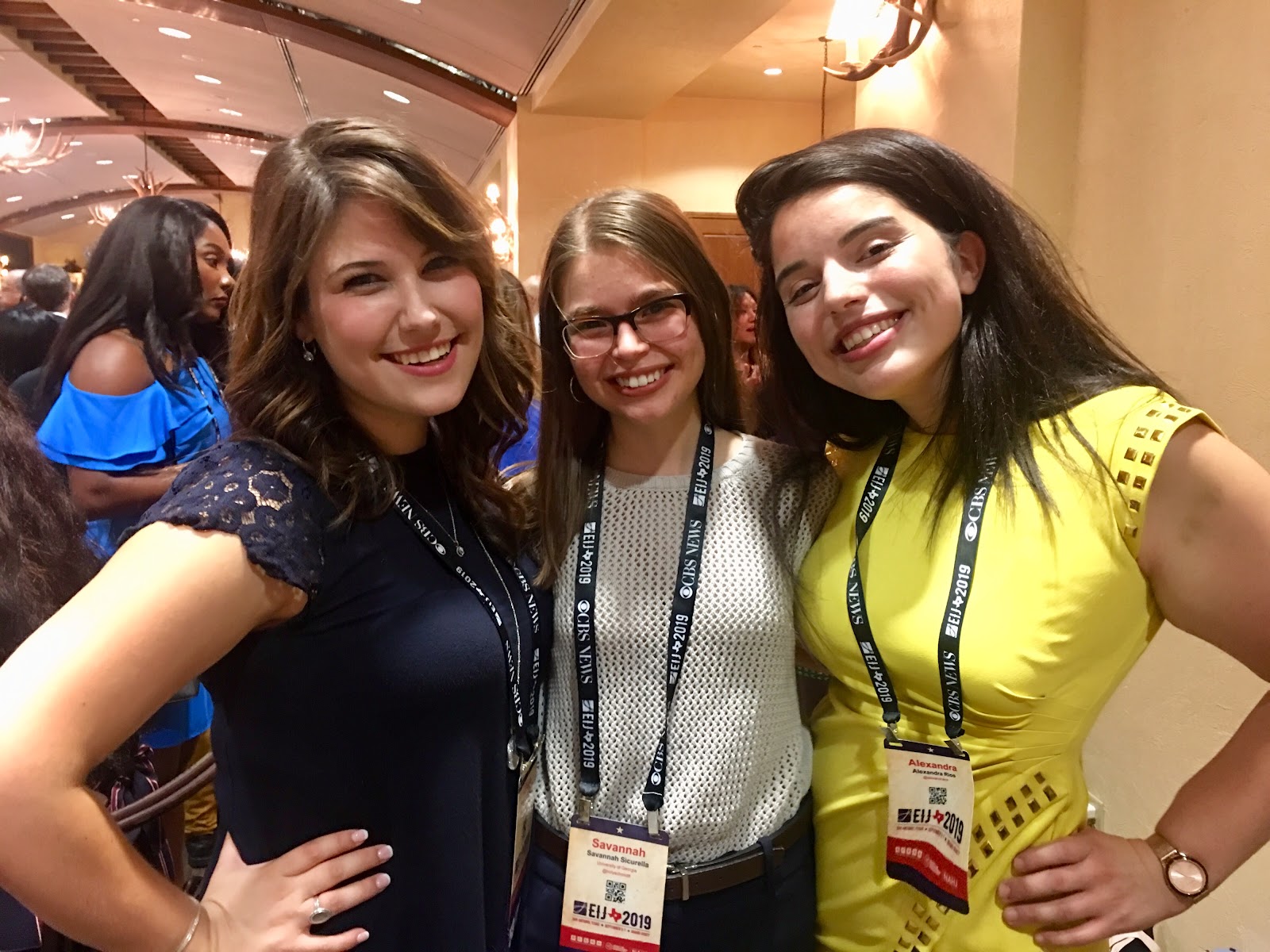
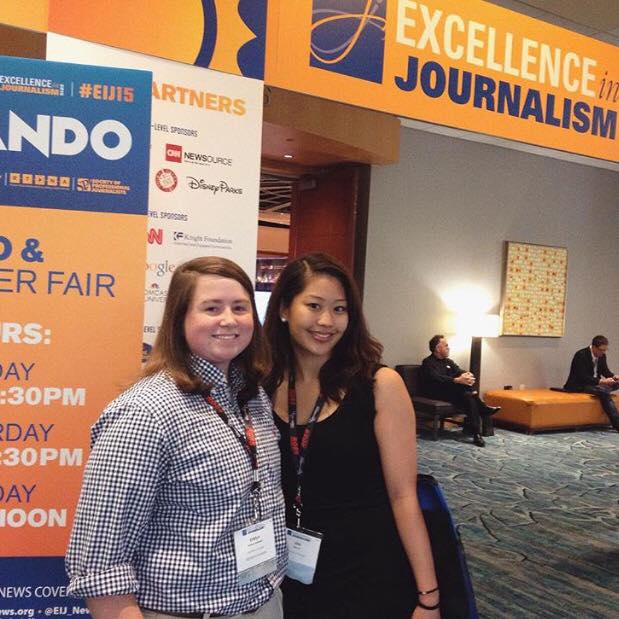
Savannah Sicurella and I had the honor and privilege of representing the University of Georgia’s chapter of Society of Professional Journalists at the 2019 Excellence in Journalism conference in San Antonio, Texas from Sept. 5-7.
This year, we had even more Grady representation since the Society of Professional Journalists partnered with the National Association of Hispanic Journalists for the EIJ Conference. Grady students Alex Rios and Ashley Soriano represented the UGA Chapter of NAHJ.
It was three days packed with learning the latest and greatest about the journalism field. Industry professionals tackled issues such as how to report on immigration and the upcoming 2020 election in these sessions.
We also left the conference with useful tools that we can bring back to Grady and incorporate into our own reporting and writing including visualizing data on digital and broadcast platforms, developing longer-form reporting into podcasts, beginning your freelancing career, writing to your audience and routinely filing open records requests.
We even had the chance to network with journalism professionals. To name a few, we spoke to journalists from the Wall Street Journal, the New York Times, USA Today, TEGNA, ABC News and Gray Television.
After sessions ended for the day, we had the chance to explore the beautiful city of San Antonio—-from the historic Alamo to the enchanting River Walk. We also saw John Quiñones casually walking down the street from our hotel—you know, no big deal.
And what’s a trip to San Antonio without grabbing a bite of Tex Mex?! We stopped by Mi Tierra in the Market Square and tried some of the best Tex Mex in the city.
What a week full of fun, adventure and learning! We’re so thankful to Grady College for giving us this amazing opportunity.

By Kelly Mayes, vice president and Joshua Tillman, executive planner
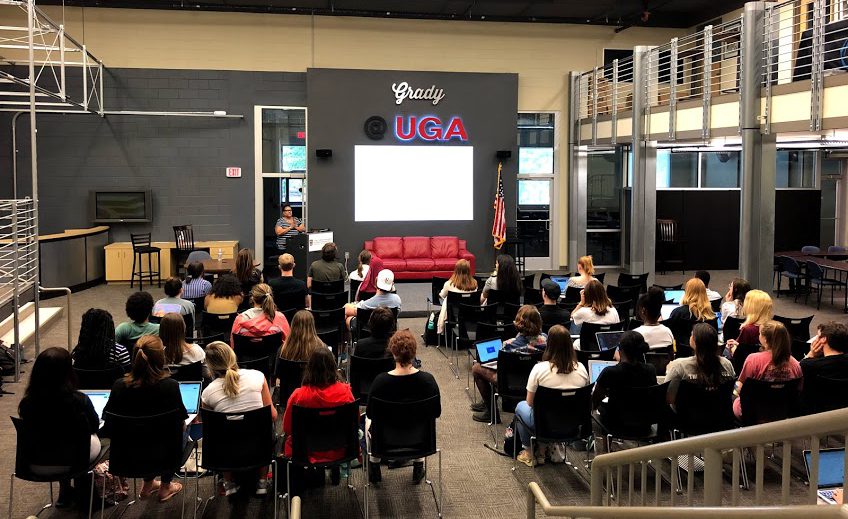
ONA and SPJ’s first meeting of the semester was a Google News Initiative training session with guest speaker, Benét J. Wilson on Tuesday, Aug. 27 at 5:30 p.m.
Wilson’s presentation began with a synopsis of her ascent into the world of aviation writing. She then gave a little bit of background on the Google training program during which she gained knowledge and skills to teach both student journalists, and journalists who have been in the field for years.
Wilson gave an in-depth presentation about tools, tips and tricks for using Google as journalists. She taught attendees about ways journalists can use Google Translate, Google Scholar, and Google Reverse Images to expedite and further their reporting.
All of these services are free, and are a great way to verify pictures, sources, and any other relevant information needed for a story.
We were pleased to have around 50-75 people in attendance at this meeting. Both Grady Faculty members and students came out to learn more about these tools.
You know that feeling you get when you’re in the presence of innovation? The kind that makes you say “Whoa”?
That’s how I felt when I first toured the University of Georgia. I got that feeling again when I began taking classes at the Grady College of Journalism and Mass Communication and again when I attended #ONA15, an annual conference held by the Online News Association.
In Los Angeles, where the conference was held, I looked around at the other attendees with awe. Discussions between reporters, editors, designers and coders about the latest trends and next big thing in journalism filled the various conference rooms, and I attempted eavesdrop on every conversation I could. As a student interested in how digital technology can help transform news, I was inspired.
I am thrilled to be serving as the first student representative for the Online News Association Board of Directors beginning Jan. 1. As an organization, ONA strives to be a launching point for innovation in story-telling, a resource for journalists and a supporter of ethics, best practices and development. And the staff members and directors in charge don’t just talk the talk.
The nonprofit sponsors training and networking opportunities as well as professional development opportunities.
The best part is that these networks are available to UGA students locally through ONA/SPJ. As a resource, ONA has given the club encouragement to create programming sessions we call Code Your @$$ Off and experimentation courses such as the Mobile News Lab. Those programs, in turn, helped launch internships for some of our members.
I’m developing plans increase opportunities for students through my position on the board.
If you have any comments or suggestions, please feel free to reach out.
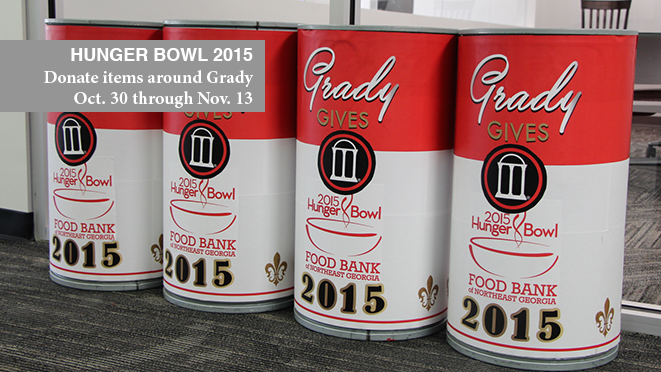
Thank you to everyone who brought in cans and money donations for this year’s Hunger Bowl.
Because of your help, ONA/SPJ won the Grady College student organization competition by 150 percent. Yes, that means a free pizza party courtesy of the journalism school.
We asked students to bring in cans in exchange for free pizza from our organization.
TONIGHT: Politcal Gabfest! Studio 100, Grady College, 6:30. Bring donations to enjoy some pizza!
— ONA and SPJ at UGA (@ONASPJatUGA) November 10, 2015
Come eat pizza with us! You can have the garlic sauce 😉 #uga18 #uga17 #PoliticsNPizza pic.twitter.com/hKpzKVZske
— ONA and SPJ at UGA (@ONASPJatUGA) November 10, 2015
In addition, we hosted a political chatter hours before the Nov. 10 GOP debate.
Here are a few responses to some of the questions people asked.
Fernanda Perez lists three issues she believes are important to consider in 2016 presidential election. pic.twitter.com/HKr6ZQwObL
— ONA and SPJ at UGA (@ONASPJatUGA) November 10, 2015
Question: To what extent have moderators been neutral participants in debates? pic.twitter.com/xHdy2EezDL
— ONA and SPJ at UGA (@ONASPJatUGA) November 10, 2015
Join us for our last event of the semester. Help us help Grady raise donations for #HungerBowl2015.
Check out this PSA from Grady Dean Charles Davis and Miss Georgia Adeline Kenerly.
Thank you to our keynote speaker, Cathy Farr of CNN for talking to us about emerging technology during our certificate dinner.
Congrats to the 2015 Mobile News Lab participants! Thanks to @KeithLHerndon @cathyrfarr #CoxInst #MNL15 @UGAGrady pic.twitter.com/lWIukyWeUJ
— ONA and SPJ at UGA (@ONASPJatUGA) October 20, 2015
Here are some tweets highlighting her talk:
.@CNN's Cathy Farr: There aren't destination websites anymore. People want to know what Facebook says, what Twitter says.
— ONA and SPJ at UGA (@ONASPJatUGA) October 19, 2015
"The mobile environment is changing faster than it ever has before" – Cathy Farr, Director of Mobile and Emerging Technologies @CNN
— Macey Kessler (@MaceyKessler) October 19, 2015
Broadcast side of @CNN still important, despite emphasis on mobile/digital. Farr points to 9/11: "Ppl needed to be told that news" #CoxInst
— Grace Donnelly (@gddonnelly22) October 19, 2015
Learn the products that no one wants. Those are the ones that will surprise you and take off. – Cathy Farr of @CNN
— ONA and SPJ at UGA (@ONASPJatUGA) October 19, 2015
During the dinner, ONA/SPJ and the Cox Institute recognized participants Macey Kessler and Alison Menhart for being voted best mobile news package.
@Macey_Kessler @MenhartAlison @UGAGrady Check out their @storehousehq package here: https://t.co/i8n00Mbrql
— ONA and SPJ at UGA (@ONASPJatUGA) October 19, 2015
Check out this video featuring participants from the Fall 2015 Mobile News Lab, presented by ONA/SPJ and the Cox Institute.
This is the first post in a new series in which we examine the journalistic ethics and practices of major news events. This week, we discuss our thoughts related to covering capital punishments.

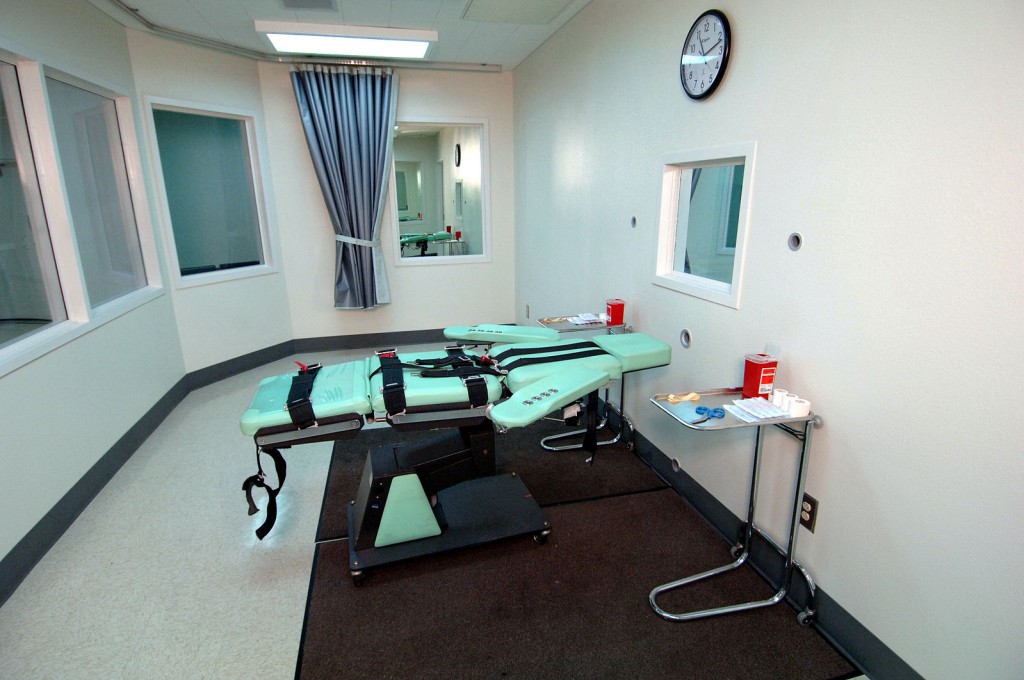
While journalists are often witnesses to executions, Kelly Gissendaner’s death, which marked the first of a woman in Georgia in 70 years, was surrounded by increased media coverage.
Gissendaner was executed by lethal injection in Georgia just after midnight on Sept. 30 for her involvement in the 1997 murder of her husband. Five members of the media were present to watch her state-enforced death.
Here are a few discussion points we thought of when considering execution coverage.
- What are the benefits of journalists present in witnessing an execution?
- Given technological advances, what digital technology and social media platforms are best used to report the story?
- Is live tweeting appropriate or should coverage wait until after the execution is complete?
- Should the reporter assigned to cover the execution also write a first person narrative?
- What privacies should be maintained on the part of the convict?
What do you think? Tweet us your thoughts at @ONASPJatUGA.
With so many exciting components of Online News Association’s 2015 conference, it was easy to miss a session here or there while listening to another. Thankfully, 20 students chronicled every aspect of the conference so you can #FOMO no more.
Here are five student-produced stories we enjoyed reading.
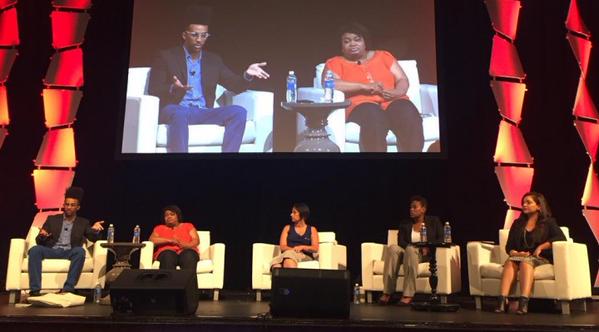
- Will You Be ‘The Black’ Reporter? How do you ensure the stories from your community are told in a responsible way? How do you balance telling the story when you become part of the story? That’s what Tanzila Ahmed, Meredith Clark and Sharis Delgadillo talked about in a panel moderated by Dexter Thomas Jr. and Tracie Powell Thursday. Recent headlines involving Ahmed Mohammed and Sandra Bland were brought to the attention of mainstream media through social media. Their influence was discussed in a story written by our Vice President Kendall Trammell. Read more of her stories here.
- Keynote: To Trust Google or Not? Trust issues with the news? You’re not alone. In an open and honest session with Richard Gingras, he talked about the increased efforts Google News has taken to ensure the most trustworthy and credible news sources are presented for consumers. In a story written by Sneha Antony, he said “the objective isn’t about how we improve the quality of journalism. It is how do we make sure that the quality of journalism that is there is understood to be just that.”
- This story is a failure (so bake a cake) In an increasingly digital age, we all need a gentle reminder every now and then that we’re human. In a panel titled “Fail Fest 2015: I Failed, It Sucked, But Here’s How I Bounced Back,” three journalists spoke about what they learned from their biggest errors. According to a story written by Katy Mersmann, baking a cake before pitching a story idea can help settle your editors. If it doesn’t work, at least you still have cake.
- Newsroom silence: What journalists don’t discuss at work The thing many journalists keep to themselves is often what eats at them the most: work-related stress. In a story written by Genevieve Scarano about an ONA15 Table Talk, journalists discussed how the anxieties of the industry can take a toll on their mental health and productivity in the office. One potential solution? Newsroom sponsored wellness programs.
- When Did You Know You Would Become a Journalist? This video produced by Sneha Antony and Shuyao Chen gives us all the right feels. From driving by a newspaper office in London to demanding details about a fatal accident in Iran, five professional journalists reminisce on the moment they realized they were meant to go into the mass communication industry.
Read more from the student journalists here.